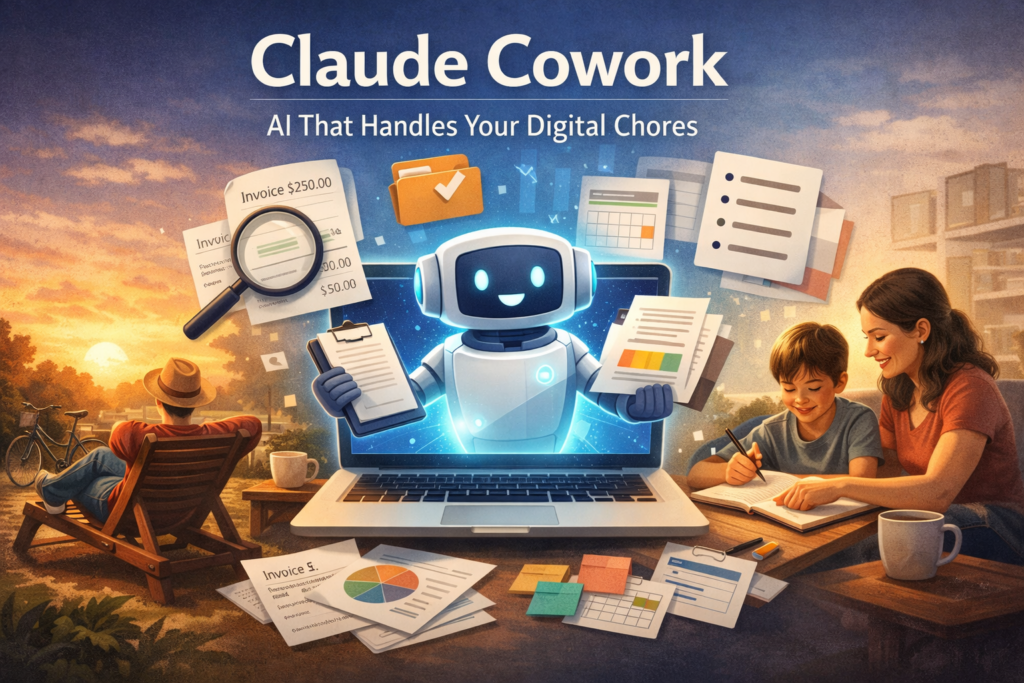
You don't need another AI chat tool.
You need an AI that gets things done without you babysitting it.
That's Claude Cowork.
What Is Claude Cowork?
Claude Cowork is a desktop tool that lets you hand off real work to Claude—Anthropic's AI—and walk away while it runs in the background.
You're not sitting there watching it type. You're not copying and pasting between windows. You set it up, hit go, and come back when it's done.
Anthropic launched Cowork in January 2026 as a research preview Claude, initially for Max subscribers and later expanded to Pro, Team, and Enterprise plans. It's built into the Claude Desktop app for macOS, with broader availability coming.
The tool grew out of something Anthropic noticed:developers were using Claude Code—their terminal-based coding tool—for all kinds of non-coding work. People were sorting vacation photos, organizing receipts, and managing files. VentureBeat Anthropic saw an opportunity to make that power accessible to everyone, not just people comfortable with command-line interfaces.
How It Actually Works
Here's what happens in my workflow:
- You give Claude a task through the desktop app
- Claude accesses your files and folders directly (if you've granted permission)
- It runs the task in the background
- You get a notification when it's finished
In my setup, I can:
- Process a folder of meeting notes and get a summary doc
- Turn a transcript into a blog post draft
- Reorganize files based on content or topic
- Pull insights from a batch of PDFs
I'm not holding its hand. I'm doing other things.
The tool works by giving Claude access to a specific folder you choose on your computer. Claude can read, edit, or create files in that folder. Claude You maintain control over what it can see and do.
What Makes This Different From Regular Chat
When you use Claude in a regular chat window, you're having a conversation. You ask a question, Claude responds, you ask another question.
With Cowork, you're delegating work.
In Cowork, Claude completes tasks with much more agency than you'd see in a regular conversation. Once you've set it a task, Claude will make a plan and steadily complete it. Claude
You can queue up multiple tasks and let Claude work through them. It feels less like a back-and-forth and more like leaving messages for a coworker. Claude
That's the shift. You're not managing Claude's every move. You're pointing it at a problem and letting it figure out the steps.
The Technology Behind It
Cowork is built on the same agent architecture as Claude Code DataCamp, which has been one of Anthropic's most successful products since launching in late 2024.
What's interesting:Anthropic's team built Cowork in approximately a week and a half, largely using Claude Code itself. VentureBeat AI building AI tools.
The tool uses what's called a filesystem sandbox Substack—a contained environment where Claude can work with your files without accessing anything else on your computer. It runs within a virtual machine using Apple's Virtualization Framework, providing isolation from the host operating system. InfoQ
In my experience, this matters because it means Claude can only touch what you explicitly give it access to. Everything else stays locked down.
Skills and Connectors
Cowork gets more powerful when you add Skills and Connectors.
Skills give Cowork native handling for office file formats:xlsx, pptx, docx, and pdf. The pdf skill goes beyond basic reading to support merging, splitting, and form-filling. DataCamp
Connectors link Claude to external services and data sources. DataCamp In Cowork, they gain a new dimension:filesystem access. A connector that pulls data from an external service can now save that data locally, or use local files as input for external actions.
The catalog already has hundreds of options:AWS Marketplace for cloud resources, n8n for workflow automation, Honeycomb for observability data, Fellow.ai for meeting insights. DataCamp
Why I Use Claude (and Not ChatGPT)
I'm not saying one is “better.” I'm saying they serve different purposes in my experience.
In my workflow, Claude handles analysis, summarization, and reasoning tasks more reliably—especially when I'm working with long documents or need it to maintain context across multiple files. (This aligns with Anthropic's positioning of Claude as optimized for nuanced, context-heavy work.)
ChatGPT, in my view, is excellent for brainstorming, exploration, and dialogue. It's conversational and fast. But when I need something built, written, or processed without back-and-forth, I use Claude.
What This Means for My Day
Here's what this looks like in practice:
Before, I'd spend hours summarizing interviews, organizing notes, or drafting content from raw material.
Now, in my experience, that work takes minutes—because I'm not doing it. Claude is.
I don't think most people care how the work gets done. They care that it gets done right, and that they get their time back.
Claude Cowork gives me that.
Real-World Use Cases
Let me get specific about what I've used this for:
Podcast production:I point Claude at a folder of interview transcripts. It pulls out key quotes, identifies main themes, and generates show notes with timestamps. What used to take me two hours now happens while I'm editing audio.
Client deliverables:I have folders of research notes, client briefs, and reference materials. Claude synthesizes all of it into a first draft of whatever I need—proposals, reports, documentation. I review and polish, but the heavy lifting is done.
File organization:My downloads folder is a disaster. Claude looks at file types, content, and metadata, then creates a sensible folder structure and moves everything where it belongs. I don't have to think about it.
Content repurposing:I write blog posts, record podcast episodes, and create social content. Claude can take one piece of content and adapt it for multiple formats. One interview becomes a blog post, a LinkedIn article, and email newsletter content.
Who This Is For
This setup works for me because:
- I work with a lot of text-based content
- I need summaries, drafts, and organization—not conversation
- I want tools that respect my time and my files
If that sounds like you, Claude Cowork might be worth exploring.
According to Anthropic's pricing structure, Cowork is available to Claude Pro subscribers at $20/month, and Claude Max subscribers at $100 or $200/month tiers, with Max users receiving higher rate limits and priority access Let's Data Science.
If you want to talk through ideas or get quick answers, stick with a chat interface. But if you want to offload real work and move on with your day, this is the tool I use.
What You Should Know Before You Start
Anthropic is transparent about the risks:Claude can take potentially destructive actions (such as deleting local files) if instructed to. Claude They recommend making instructions as clear and unambiguous as possible.
Like any AI agent, Claude Cowork comes with security risks, particularly around “prompt injections,” where attackers trick LLMs into changing course by inserting malicious, hidden instructions into webpages, images, links, or any content found on the open web. Fortune
In Cowork, you can choose which folders and connectors Claude can see:Claude can't read or edit anything you don't give it explicit access to. Claude will also ask before taking any significant actions, so you can steer or course-correct it as you need. Claude
In my experience, starting small is smart. Point Claude at a test folder first. See how it handles basic tasks before you give it access to anything critical. And yes, back up your files. That's good practice anyway.
Where This Is Headed
With Cowork, Anthropic is competing more directly with tools like Microsoft's Copilot for the enterprise productivity market. VentureBeat
The difference, as I see it, is approach. Microsoft built an assistant and added agent capabilities. Anthropic built a powerful agent and is now making it accessible to more people.
Programmer Simon Willison noted that Claude Cowork is essentially Claude Code wrapped in a less intimidating interface with a filesystem sandbox configured without users needing to know what a “filesystem sandbox” is. Substack
That matters. The underlying power was already there. Cowork just makes it usable for the rest of us.
Bottom Line
Claude Cowork isn't perfect. It's still in research preview. You'll run into limitations. But for the kind of work I do—processing content, organizing information, creating documents—it's changed how I spend my time.
I used to do a lot of work with AI tools. Now I do a lot of work through them.
That's the shift.