Quick guide
Quick answer
AI After 50:You’re Not Too Old to Learn
What you'll find here
- People Over 50 Are Already Using Technology
- You Don’t Need to Become an AI Expert
- AI Doesn’t Require a New Personality
- Start With Your Life, Not With AI
AI After 50:You’re Not Too Old to Learn
- You are not too old to learn artificial intelligence. Start with practical AI skills that build on the technology and experience you already have. Start today.
If you’re over 50 and artificial intelligence feels like something that arrived overnight, you’re not imagining things.
One minute people were talking about smartphones, social media, and working from home.
Then suddenly everybody seemed to be talking about ChatGPT, Claude, AI agents, AI assistants, automation, image generators, AI video, and artificial intelligence taking over everything from office work to Hollywood.
It can feel like you missed a meeting.
You didn’t.
And you’re definitely not too old to learn how to use AI.
In fact, I think people over 50 may have an advantage that doesn’t get enough attention.
We’ve already been through this before.
Not artificial intelligence specifically, but massive changes in technology.
If you’re in your 50s, 60s, or older, think about the amount of technology that has entered everyday life during your lifetime.
You probably remember when a telephone was attached to a wall.
You may remember getting your first answering machine.
You remember when there was no Google.
No smartphones.
No GPS telling you where to turn.
No online banking.
No Amazon package arriving at your house the day after you ordered something.
No Zoom meetings.
No streaming television.
No social media.
No apps.
No Wi-Fi.
Some of us remember when getting online involved listening to a modem make noises that sounded like two robots arguing inside a metal trash can.
And somehow we survived.
We learned.
That’s the first thing I want people over 50 to understand about artificial intelligence.
You’ve already proved that you can adapt to technology.
AI is simply the next thing you need to decide whether and how to use.
People Over 50 Are Already Using Technology
There’s a stereotype that older adults don’t understand technology.
The numbers don’t support that stereotype.
Pew Research Center’s 2025 data found that 90% of Americans ages 50 to 64 owned a smartphone. Even among adults 65 and older, smartphone ownership reached 78%. (Pew Research Center)
AARP has also been tracking technology use among adults over 50.
Its research shows substantial use of smartphones, e-commerce, online financial services, smart devices, and increasingly generative AI.
AARP reported that generative AI use among adults 50+ rose from 9% in 2023 to 18% in 2024 and 30% in 2025. (AARP)
That’s a pretty significant increase in a short period of time.
So the story isn’t:
“People over 50 can’t understand AI.”
The more accurate story is:
“A lot of people over 50 are still deciding whether AI has enough value to make learning it worthwhile.”
That’s a much more reasonable question.
And frankly, it’s the question everyone should be asking.
You don’t need AI just because someone on the internet says you do.
The technology needs to earn a place in your life.
You Don’t Need to Become an AI Expert
This is where I think the technology industry occasionally gets in its own way.
If you’re curious about AI, you’ll quickly encounter terms like:
- large language models
- tokens
- context windows
- neural networks
- multimodal models
- APIs
- agents
- RAG
- inference
- parameters
- fine-tuning
Those things matter if you’re developing AI systems.
They don’t necessarily matter if you want help writing an email.
That’s an important distinction.
Imagine if you had to understand exactly how your smartphone’s processor worked before anyone allowed you to send a text message.
Most of us would still be sending postcards.
You don’t need to understand every technical detail of generative AI to use ChatGPT, Claude, Gemini, or another AI assistant productively.
You need a handful of practical skills.
You need to know how to:
- Explain what you’re trying to accomplish.
- Give the AI enough context.
- Ask follow-up questions.
- recognize when an answer doesn’t make sense.
- Verify important information.
- Protect sensitive information.
- Make the final decision yourself.
That’s manageable.
AI Doesn’t Require a New Personality
Another misconception about AI is that you have to become some kind of “AI person.”
You don’t.
You don’t have to start talking about algorithms at dinner.
You don’t have to follow every AI company on social media.
You don’t have to spend four hours every morning reading AI newsletters.
You don’t need 37 AI subscriptions.
You don’t need to build a robot.
You don’t even need to call yourself an AI enthusiast.
Instead, think of AI the way you think about Google, GPS, or a calculator.
Use it when it makes sense.
Ignore it when it doesn’t.
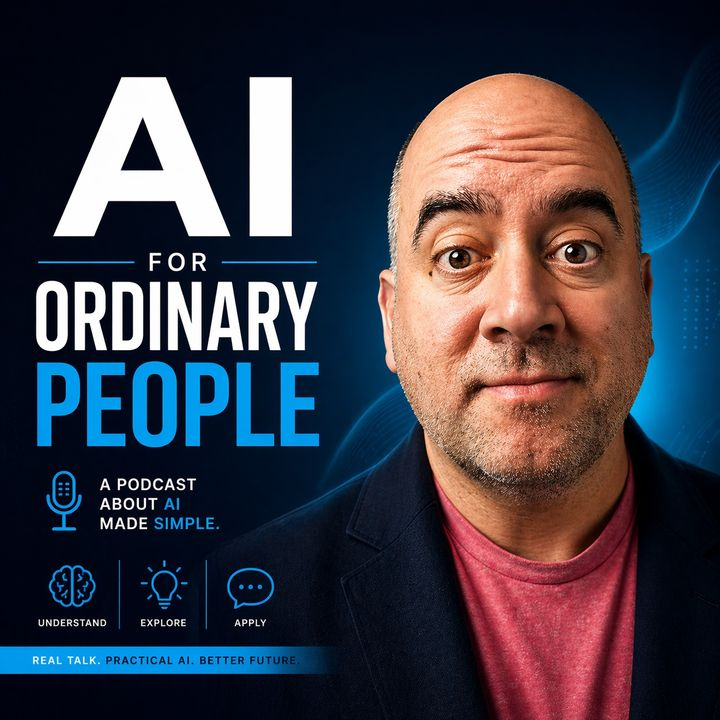
That’s one reason I created AI for Ordinary People.
I’m less interested in what AI can theoretically do than in what an ordinary person can actually do with it today.
Can it save you 30 minutes?
Can it explain something confusing?
Can it help you organize something you’ve been putting off?
Can it help you ask better questions?
Can it help you look at a problem differently?
Those are much more interesting questions to me.
Start With Your Life, Not With AI
If you’re new to artificial intelligence, don’t start by asking:
“What can AI do?”
That question is enormous.
You will get enormous answers.
Instead ask:
“What do I already do that annoys me, takes too long, or feels harder than it should?”
Now we’re getting somewhere.
Think about an average week.
Maybe you regularly spend time:
- figuring out what to cook
- researching purchases
- writing emails
- planning appointments
- comparing products
- organizing notes
- researching travel
- creating shopping lists
- learning unfamiliar topics
- preparing for meetings
- creating social posts
- working on a hobby
- helping a child or grandchild understand something
- organizing paperwork
- planning a family event
Pick one.
Then see whether AI can make that job easier.
That’s a much better introduction to AI than trying to learn everything.
Example:Planning Meals
Imagine it’s Thursday.
You’re tired.
You look in the refrigerator and see chicken, peppers, half an onion, some cheese, and leftovers that may or may not legally qualify as food anymore.
You could ask an AI assistant:
“I have chicken breasts, peppers, onion, shredded cheese, rice, eggs, and basic seasonings. Give me three simple dinner ideas that take less than 30 minutes. Ask me before assuming I have additional ingredients.”
That’s AI.
No coding.
No automation.
No artificial general intelligence.
Dinner.
And sometimes dinner is enough.
Example:Comparing a Purchase
Suppose you’re trying to choose between two lawn mowers, televisions, computers, fishing rods, cameras, or vehicles.
You can give an AI assistant the specifications and say:
“Compare these for someone who cares most about reliability, ease of use, and long-term cost. Create a simple table. Then tell me what information I should verify before buying.”
Notice that last sentence.
You’re not asking the AI to make the decision.
You’re asking it to help you organize the decision.
That’s an important distinction.
Example:Understanding Something Confusing
Sometimes the best AI prompt is simply:
“Explain this to me in plain English.”
You can take complicated language from a manual, document, article, or technical explanation and ask AI to break it down.
Then you can ask:
“Give me an example.”
Or:
“What questions should I ask next?”
This is where conversational AI becomes very different from traditional internet search.
A search engine primarily helps you locate information.
An AI assistant can help you work through information interactively.
You can keep asking questions.
Your Experience Is an Advantage
There is something people over 50 bring to AI that younger users cannot magically download.
Experience.
You’ve seen ideas fail.
You’ve seen fads.
You’ve made mistakes.
You’ve dealt with bosses, customers, coworkers, mortgages, kids, bills, relationships, health decisions, home repairs, and probably more than your fair share of ridiculous bureaucracy.
That experience gives you context.
AI can generate an answer quickly.
It doesn’t mean the answer makes sense.
That’s where judgment enters the picture.
An AI system might suggest ten business ideas.
Your experience may immediately tell you that seven are unrealistic.
AI might draft an email.
You know whether it sounds like something you’d actually say.
AI might suggest how to handle a work situation.
You know something important about the people involved that isn’t contained in the prompt.
This is why I don’t like the idea of using AI as a replacement for thinking.
I prefer using it as another tool for thinking.
AI Should Give You Options, Not Orders
This is the way I personally think about AI.
I can ask AI to give me options.
I can ask it to challenge my thinking.
I can ask it to point out something I’ve missed.
I can ask it to organize information.
I can ask it to explain the pros and cons.
But I still decide.
That distinction becomes especially important when the stakes are high.
The National Institute of Standards and Technology, better known as NIST, specifically warns about a problem it calls confabulation.
Most people know the same phenomenon as an AI “hallucination.”
It occurs when a generative AI system produces false or erroneous information and presents it as though it were true. NIST notes that generative AI can even produce fabricated citations or reasoning that looks convincing. (NIST Publications)
That means AI confidence isn’t proof.
A beautifully written answer can still be wrong.
So your experience matters.
Your skepticism matters.
Your ability to stop and ask, “Does that actually make sense?” matters.
Those aren’t weaknesses.
They’re AI skills.
Don’t Try to Learn Every AI Tool
Another easy mistake is tool collecting.
You start with ChatGPT.
Then someone mentions Claude.
Then Gemini.
Then Perplexity.
Then some new product launches Wednesday afternoon and everybody declares that every previous AI tool is obsolete.
By Thursday somebody has posted a 47-minute YouTube video explaining why civilization changed overnight.
Ignore most of it.
Seriously.
Pick one mainstream AI assistant.
Learn it.
If you use ChatGPT, spend time learning ChatGPT.
If you prefer Claude, learn Claude.
If you use Gemini because it’s connected to tools you already use, learn Gemini.
Once you’re comfortable, explore other tools.
You don’t learn to drive by buying six cars.
Try This Simple AI Exercise
Open the AI assistant you use and enter this:
I’m new to using AI practically. Ask me five questions about the things I do during a normal week. After I answer, identify three tasks where AI could realistically save me time or make something easier. Keep the ideas simple. Don’t suggest complicated automation or coding.
Answer the questions honestly.
Then look at the three suggestions.
Pick one.
Try it.
That’s enough for your first experiment.
A Seven-Day AI Challenge
If you want a slightly more structured approach, spend one week experimenting.
Day 1:Ask AI to explain something
Pick a topic you’ve always wondered about.
Ask:
“Explain this like I’m intelligent but completely new to the subject.”
That wording is important.
Simple doesn’t have to mean childish.
Day 2:Use AI for writing
Take an email you’ve been struggling with.
Write the rough version yourself.
Then ask AI:
“Clean this up while keeping my tone. Don’t make it sound corporate.”
Review every word before sending it.
Day 3:Compare something
Choose two products, services, travel options, or ideas.
Ask AI for a side-by-side comparison.
Day 4:Plan something
Ask AI to help create:
- a weekend itinerary
- a grocery list
- a home project
- a workout question list
- a fishing trip
- a family event
- a learning plan
Day 5:Organize something
Paste in notes or ideas and ask:
“Organize this without removing any important information.”
Day 6:Challenge the AI
Take one answer and ask:
“What could be wrong with this answer? What should I verify?”
This may be one of the most important AI habits you learn.
Day 7:Evaluate
Don’t ask whether AI was impressive.
Ask:
Was it useful?
Which task became easier?
Which didn’t?
What would you use again?
That’s your AI strategy.
Privacy Still Matters
Convenience doesn’t eliminate common sense.
Before giving personal information to an AI service, understand the service’s privacy controls and policies.
Different products and account types can handle data differently.
For example, OpenAI provides controls that allow ChatGPT users to manage whether future conversations can be used to improve models, and it offers Temporary Chat for conversations users do not want stored in normal chat history or used for training. (OpenAI)
That’s useful.
It doesn’t mean you should dump every private document you own into an AI assistant.
Think before sharing:
- Social Security numbers
- passwords
- complete banking information
- confidential workplace information
- private information belonging to other people
- highly sensitive records
The same internet rules you’ve spent years learning still apply.
People Over 50 Don’t Need AI Designed Like a Science Experiment
AARP research offers another important clue about adoption.
Adults over 50 show more interest in AI when it solves practical problems, simplifies information, increases convenience, or improves something they’re already doing.
They’re generally less enthusiastic about AI simply replacing humans for the sake of replacement. (AARP)
I think that’s sensible.
Technology should solve a problem.
We shouldn’t have to invent a problem because a company invented technology.
You Don’t Need to Catch Up
This might be the most important point in this entire article.
Stop thinking you’re behind.
There isn’t some giant class of people who completely understand what’s happening with artificial intelligence.
Even people who work with AI constantly are adapting to new capabilities, tools, limitations, and changes.
The field moves quickly.
Nobody finishes learning AI.
So you haven’t missed the starting gun.
There isn’t one.
Start from where you are.
Learn one useful thing.
Then another.
What AI Could Mean After 50
For somebody in their 50s, AI may become especially interesting.
You may still have another decade or two of work ahead.
You may be thinking about changing careers.
Starting a business.
Creating extra income.
Writing something.
Teaching.
Consulting.
Helping your family.
Exploring a hobby.
Traveling.
Learning something completely new.
AI can potentially reduce the friction between having an idea and trying it.
Someone who’s spent 25 or 30 years developing expertise can use AI to help organize that knowledge.
A good interviewer can use AI for research.
A salesperson can use it for preparation.
A manager can use it to organize information.
A parent can use it to understand an unfamiliar school subject before helping a child.
A hobbyist can use it to research equipment.
A traveler can use it for planning.
A creator can use it to brainstorm.
The value isn’t AI by itself.
The value comes from combining the tool with what you already know.
Don’t Hand Over Your Brain
There is a legitimate concern that relying too heavily on technology can make us lazy.
We’ve already seen pieces of this.
Many of us don’t remember phone numbers anymore because our phones remember them.
We don’t memorize routes because GPS handles them.
We don’t necessarily remember facts because Google is always available.
AI creates another version of that challenge.
So create boundaries.
Think first.
Use AI second.
Ask yourself what you believe before asking the machine.
Draft something yourself occasionally.
Question the answer.
Challenge it.
Make your own decision.
AI should increase your ability to think, not eliminate your need to think.
The Goal Is Not to Become an AI Expert
If you’re over 50 and wondering where you fit into the AI revolution, here’s my answer.
You fit exactly where you are.
You have experience.
You have problems to solve.
You have things you want to accomplish.
Now you have another tool.
That’s it.
You don’t need to compete with a 22-year-old programmer.
You don’t need to build an AI startup.
You don’t need to understand neural networks.
You don’t need to chase every new product.
You need to find a couple of things that improve your life.
Start small.
Stay skeptical.
Protect your information.
Check important facts.
Keep using your own judgment.
And don’t let somebody else’s excitement or fear decide how you feel about artificial intelligence.
You’re not too old for AI.
You’re old enough to know that every new technology comes with hype, problems, opportunities, and a learning curve.
You’ve been through this before.
You’ll figure this one out too.
Sources and Further Reading
AARP Research has detailed information about AI attitudes and adoption among adults 50+. (AARP)
Pew Research Center tracks smartphone and internet adoption by age. (Pew Research Center)
NIST’s Generative AI Risk Management Profile explains AI confabulation, reliability, and other generative AI risks. (NIST)
OpenAI explains its current consumer privacy and data controls here. (OpenAI)
AI for Ordinary People
Artificial intelligence doesn’t have to be complicated.
The goal at AIforOrdinaryPeople.com is to explore what AI can actually do for regular people, without pretending every new AI announcement is going to change civilization by Friday afternoon.

Joe Foley
Joe Foley is the creator of AI for Ordinary People. He helps beginners, parents, creators, and small business owners use AI in simple, practical ways. Joe has been podcasting since 2013 and creates plain-English guides, prompts, and workflows for people who want useful help without tech jargon. His goal is to make AI feel less confusing and more useful for real life, real work, and everyday decisions.